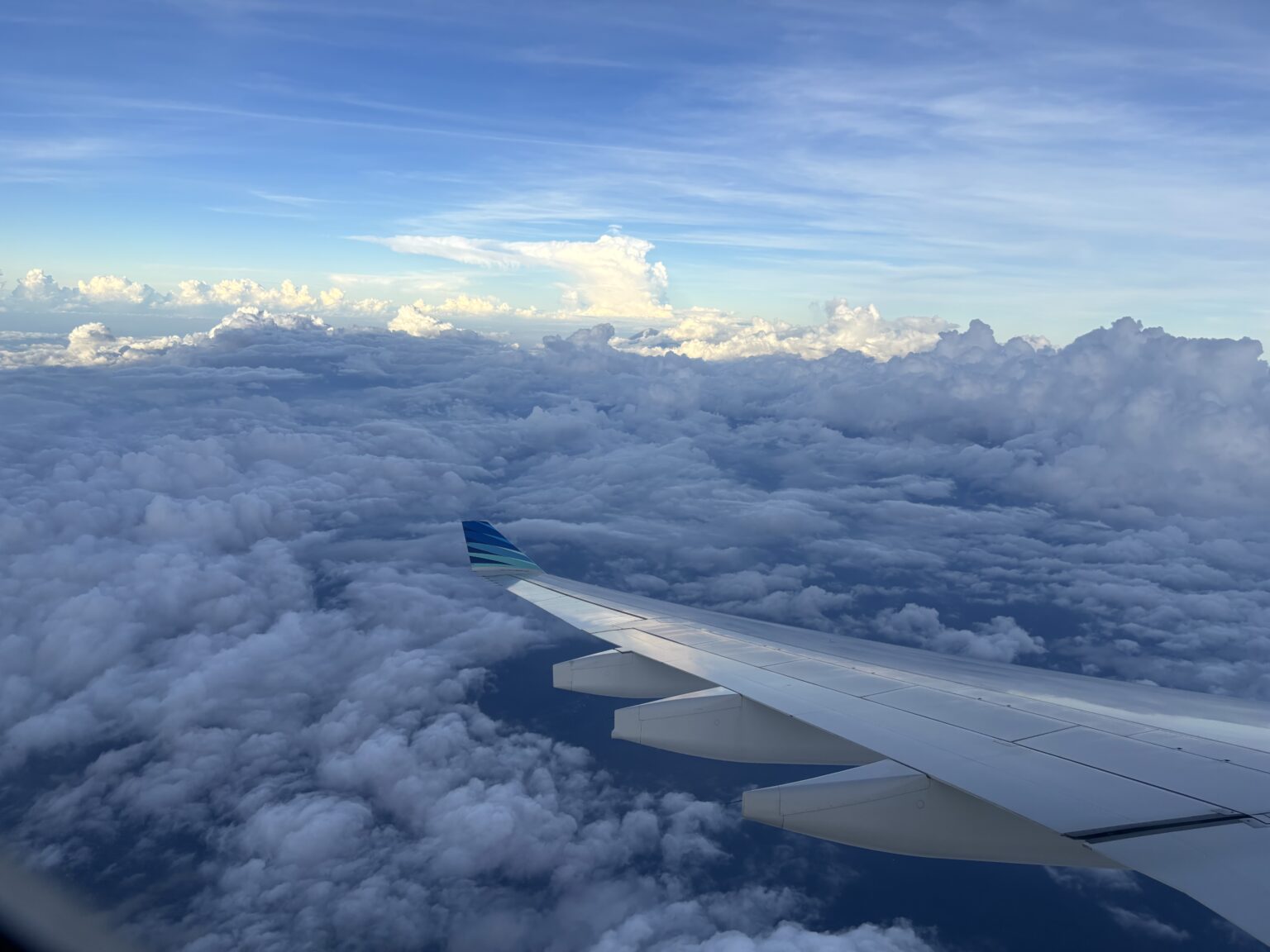
Episode 2: Ngurah Rai Airport
2026 — Choosing a Different Life: Thoughts from the Road
After leaving work, I headed to Indonesia. This series is partly a travel journal, partly something harder to name — a record of trying to figure out what comes next. I want to write down the landscapes, the people, the slow shifts happening inside me as I move through the world.
My first trip after quitting was Bali.
These past few months, a lot has shifted. My circumstances, my relationships, even the way I think about things. It all feels different now.
So this trip wasn’t about achieving anything. I just wanted to exist somewhere quietly for a while.
And arriving in Bali, I thought: yes, this was the right choice.
What follows:
The fading light at the airport / Immigration gates / Waiting for luggage / The driver I couldn’t immediately find / Night traffic into the city / Bali after dark
The Hour the Sun Goes Down at the Airport
When I stepped onto the bus to the terminal at Ngurah Rai Airport (Denpasar International), the sunset was still there in the window. Orange light settling slowly over the runways and the terminal buildings.
Oh. I’m actually in Bali.
But even as that feeling sank in, my mind drifted back to the chaos at Narita — rushing to complete the e-VOA (electronic visa on arrival), the health declaration, the customs form, all on my phone before boarding. The e-VOA has to be applied for and paid online before you arrive in Indonesia; it runs about ¥5,000 per person. I only learned this at the Garuda Indonesia check-in counter.
There’d been an earlier mix-up too — I’d bought my ticket through JAL, so I got confused about which terminal and got off the train one stop too early. Small things, but they added up.
I’d arrived at Narita with plenty of time to spare. I’d imagined sitting somewhere with a coffee. Instead, I spent that time bent over my phone, filling out forms and saving QR codes. I think I was still tapping away right up until the plane doors closed.
It all worked out — but I arrived already slightly out of breath, as if the trip had started too early.
Clearing Immigration
The regular immigration queues were long — genuinely long.
But travelers with an e-VOA and an IC passport can use the automated gates. I walked past the line, stepped up to the gate, and was through in about 30 seconds.
All that scrambling at Narita suddenly felt worth it.
Waiting for Luggage
Getting out of the airport itself, though, took much longer.
The bags were slow to come. I stood at the carousel and watched time pass.
A large man — Dutch-Indonesian, maybe — kept calling out loudly to the airport staff, pressing them to do something. Eventually, after his repeated complaints, the luggage started moving.
By then, the light outside had already shifted to night.
Long flights always leave me a little foggy. This one was no exception. I could feel my judgment running slower than usual — small decisions taking more effort, routine things requiring more concentration than they should. Just navigating the airport, standing in line, going through the motions — it was taking more out of me than I’d expected.
Maybe that’s why every small snag felt slightly bigger than it was.
Finding the Driver
Outside the terminal, I went to find my driver.
When I’d arrived, there was still that orange light over the city. By the time I found him, the sky was fully dark.
The airport’s free Wi-Fi kept dropping, and I couldn’t get the ride app to connect properly. I finally found a signal, got through, and learned he’d been waiting somewhere a little out of the way. It turned out he’d been there far longer than expected — much longer than I’d realized.
Relief and guilt arrived at the same time.
Traffic, and the Hotel
The roads out of the airport were already backed up. It took over an hour to reach the hotel.
Through the window: motorbikes woven between cars, a kind of organized density that has its own rhythm once you stop trying to make sense of it.
I found myself thinking, oddly, of Bangkok — a night trip there during university, the dark streets lit up by bright shop signs and the glow of 7-Elevens. Something about that memory felt close.
When we finally pulled up to the hotel, I felt something release in my shoulders.
But only briefly.
Check-in was in English, heavily accented — the Indonesian “R” rolled and strong, a little hard to catch at first. I nodded through more than I fully understood.
The room’s exterior door — a double French-door style — didn’t quite close in the middle. A small gap where the panels met. This used to happen in South America too, I thought. Something about things made by hand rather than machine — there’s always a little give, a little looseness. The gap lets in insects.
Into the Bali Night
Outside the window, Bali was already dark and settled into its evening.
I’d only just arrived, and yet it felt like I’d already lived a full day of travel. All I’d done was move from one place to another — and yet somehow, my body and mind felt like they’d come a very long way.
And this, I reminded myself vaguely, was still just the first night.
The trip had barely started.
I didn’t know about the swifts circling above my hotel each morning.
I didn’t know about the woman from Sumatra I would meet by the sea.
I didn’t know about the Australian man in a blue T-shirt who would help me find the beach.
And I certainly didn’t know how peaceful I would feel.
My first days in Bali turned out to be exactly what I needed.
→ Read the next post: My First Trip After Leaving My Job: Finding Peace in Bali

If this essay resonated with you,
you can support my writing here ☕
This essay is also available in Japanese and Spanish.
日本語版はこちら

Versión en español:
コメント