2026 — Choosing a Different Life: Thoughts from the Road Episode 4
After quitting my job, I headed to Indonesia. This series is partly a travel journal, partly something harder to name — a record of trying to figure out what comes next. I want to write down the landscapes, the people, the slow shifts happening inside me as I move through the world.
Toward Java — What I Noticed Before the Journey
This was the day I would leave Bali and fly to Yogyakarta, on the island of Java.
I checked out of my hotel in Sanur and made my way to Ngurah Rai Airport — about 25 minutes by car.
I wasn’t fully aware of it at the time, but looking back, this journey had already stopped feeling like ordinary travel.
A few days earlier, when I came in from Japan, the same route had taken more than an hour. The reason, which I only figured out afterward, was that the country was in the middle of a major public holiday — the kind where people extend the holiday by a day on either side and millions of people are on the move at once, similar to Japan’s Golden Week. The roads around the airport had been far more congested than I had realized.
Without realizing it, I had been caught in the country’s rhythm. Swept along by a tide I hadn’t seen coming.
A City Worth Knowing Before You Get There
Yogyakarta sits in the center of Java — the island I was heading to.
Locally, it’s almost always shortened to Jogja.
The more I looked into it before the trip, the more clearly it emerged as something other than a tourist destination.
Yogyakarta is considered the cultural heart of Javanese civilization. The old royal court tradition survives there not as historical artifact but as living institution — the Kraton Yogyakarta, the royal palace, still functions today.
At the same time, the city is one of Indonesia’s major centers of education. Gadjah Mada University draws students from across the country, and their presence gives the streets a particular energy — young, restless, intellectually alive.
Economically, Yogyakarta is not among Indonesia’s wealthier regions. But perhaps because of that, or alongside it, the city has organized itself around culture and learning rather than industry. Javanese dance, gamelan music, wayang shadow puppetry — these haven’t been preserved as performances for visitors. They’ve remained part of daily life, still practiced because people here still practice them.
It reminded me, in some way, of Kyoto. A city that chose depth over development. Though here the sense is that culture and everyday life have never quite separated — that the distance between the two was never as wide to begin with.
A City That Once Carried a Nation
Yogyakarta’s significance goes beyond culture.
After the end of the Second World War, Indonesia declared independence — but the Netherlands, the former colonial power, moved to reassert control, and the struggle continued. During that period, the capital functions of the young republic were temporarily relocated to Yogyakarta. The city became a center of the independence movement — both politically and symbolically.
A place that was, at once, the seat of government and the keeper of culture. A city that was asked to hold the idea of a nation while that nation fought for the right to exist.
That’s what I was flying toward — not a town with good temples and good food, but a place that once carried something heavier.
On the Way to the Airport
In the car on the way to Ngurah Rai, my mind drifted.
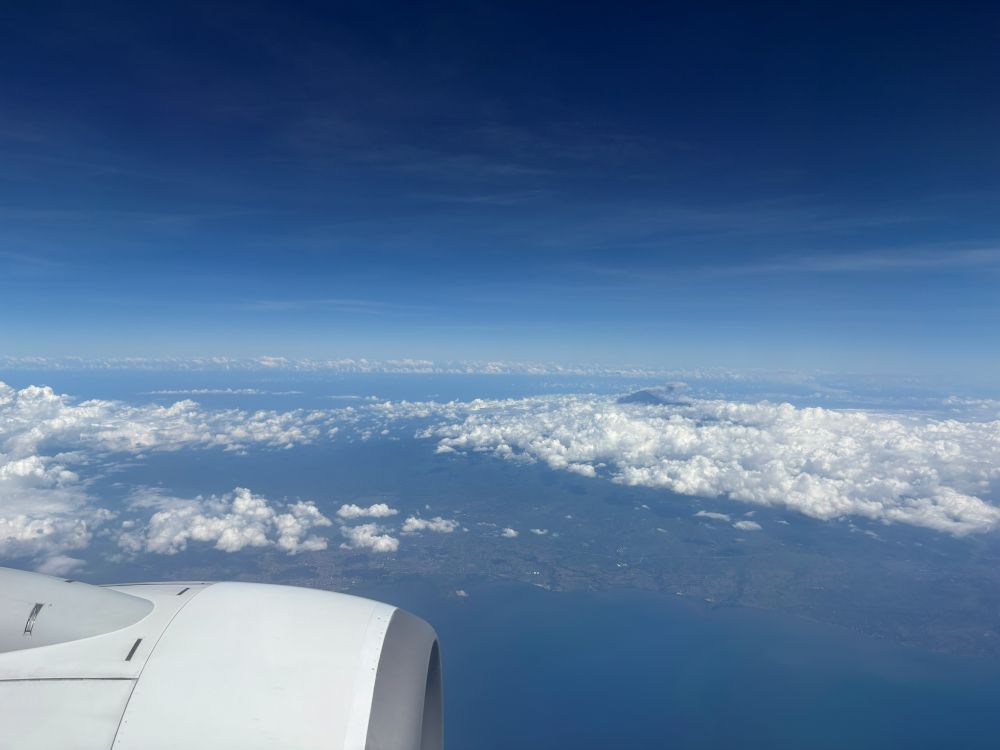
A few days ago, I was still an office worker. Now I was crossing the sky over Indonesia.
The feeling was hard to place — simultaneously a continuation of ordinary life, and a rupture from it. Both at once.
Maybe that’s what travel actually is. Not movement, but a shift in state. And maybe how you arrive somewhere matters more than where you’re going.
One Hour to Java
The flight to Java takes about an hour.
Such a small distance — and yet on the other side of it, a different history, a different culture, a different rhythm of living.
Going somewhere you’ve never been isn’t really about changing location. It’s about allowing your understanding of the world to be quietly revised, piece by piece.
What Yogyakarta would actually show me, I didn’t yet know.
What I did know was that a different kind of time existed there — not better or worse, just distinct. And I was about to step into it.
As it turned out, the Yogyakarta that greeted me was not quite the one I’d imagined from that plane.
There was confusion at the airport, persistent touts, the low-level anxiety of being without internet in an unfamiliar city.
I’ll write about that in the next installment.
▶ Read the complete collection of essays in English

This essay is also available in Japanese and Spanish.
日本語版はこちら

Versión en español:
If this essay resonated with you,
you can support my writing here ☕
コメント